Introduction
- Quantum physics studies the behavior and properties of particles at microscopic scales.
- Quantum systems can behave very differently from objects in the classical/macroscopic world.
- Quantum computing uses quantum-mechanical properties to perform computations that may provide a quantum advantage over classical computers for certain problems.
Classical Bits vs Quantum States
- Classical computers represent information using bits:
01
- Quantum computers use quantum states/qubits, which can exist in a superposition of states.
- Examples of superposition:
- Photon: superposition of horizontal and vertical polarization.
- Electron: superposition of ground and excited states.
Superposition
- Superposition means a quantum system can simultaneously contain multiple possible states before measurement.
- Superposition enables the idea of quantum parallelism.
Interference
- Interference occurs when quantum amplitudes combine.
- Depending on their relative phases, amplitudes may:
- Reinforce each other $\rightarrow$ constructive interference.
- Cancel each other $\rightarrow$ destructive interference.
- Quantum algorithms use interference to:
- Increase the probability/amplitude of correct answers.
- Suppress incorrect answers.
Quantum Measurement
- Measurement in quantum mechanics is generally probabilistic.
Carefully designed quantum algorithms combine superposition and interference so that the desired result can sometimes be obtained with certainty or very high probability.
Quantum Computers vs Classical Computers
- Quantum computers should not be considered simply faster versions of classical computers.
- Quantum computers are unlikely to completely replace classical computers.
- Instead, future computing systems may use:
where QPU = Quantum Processing Unit.
- The CPU may:
- Analyze a computational problem.
- Perform classical parts of the computation.
- Send suitable sub-problems to the QPU.
- This is similar to how CPUs currently offload suitable tasks to GPUs.
Quantum advantage does not simply come from doing classical operations faster. It comes from designing algorithms that exploit uniquely quantum effects such as superposition and interference.
Qubit and Unitaries
Qubit State in Different Bases
Computational Basis $(|0\rangle, |1\rangle)$
$$ |\psi\rangle = \alpha |0\rangle + \beta |1\rangle $$Diagonal Basis $(|+\rangle, |-\rangle)$
$$ |\psi\rangle = |+\rangle \frac{\alpha+\beta}{\sqrt{2}} + |-\rangle \frac{\alpha-\beta}{\sqrt{2}} $$Circular Basis $(|+i\rangle, |-i\rangle)$
$$ |\psi\rangle = |+i\rangle \frac{\alpha-i\beta}{\sqrt{2}} + |-i\rangle \frac{\alpha+i\beta}{\sqrt{2}} $$Important Note: All these expansions represent the same physical qubit state. Only the basis changes.
Matrix Representation of Basis States
$$ |0\rangle \equiv \begin{pmatrix} 1 \\\\ 0 \end{pmatrix}, \qquad |1\rangle \equiv \begin{pmatrix} 0 \\\\ 1 \end{pmatrix} $$$$ |+\rangle \equiv \frac{1}{\sqrt{2}} \begin{pmatrix} 1 \\\\ 1 \end{pmatrix}, \qquad |-\rangle \equiv \frac{1}{\sqrt{2}} \begin{pmatrix} 1 \\\\ -1 \end{pmatrix} $$$$ |+i\rangle \equiv \frac{1}{\sqrt{2}} \begin{pmatrix} 1 \\\\ i \end{pmatrix}, \qquad |-i\rangle \equiv \frac{1}{\sqrt{2}} \begin{pmatrix} 1 \\\\ -i \end{pmatrix} $$- We usually the $|0\rangle, |1\rangle$ basis as the computational basis, because classical computation uses 0s and 1s.
Bloch Sphere Interpretation
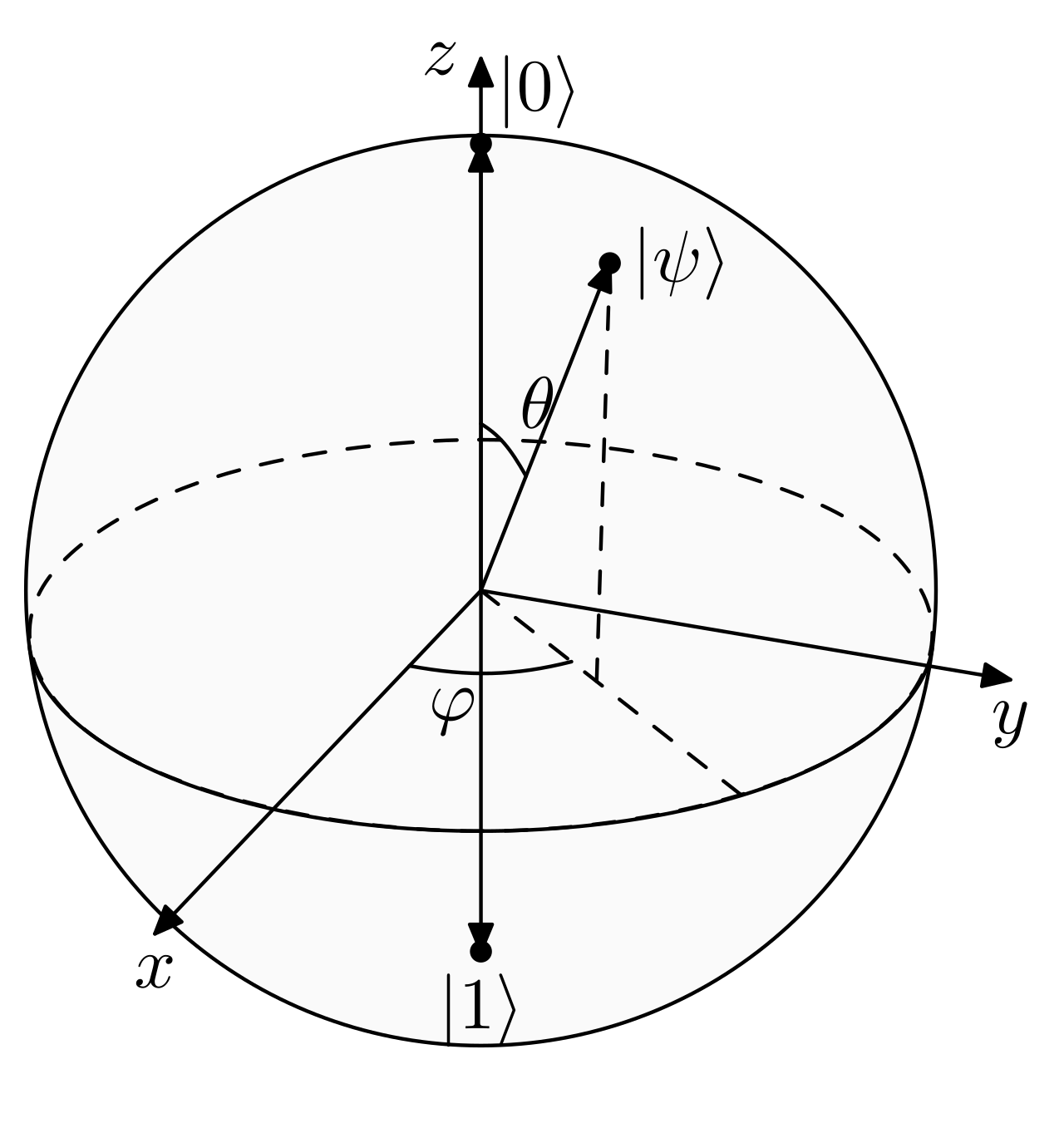
Ref: https://en.wikipedia.org/wiki/Bloch_sphere
- A pure qubit state can be visualized on the surface of the Bloch sphere.
- Standard directions:
- $|0\rangle$ corresponds to +z direction (north pole)
- $|1\rangle$ corresponds to −z direction (south pole)
- $|+\rangle, |-\rangle$ correspond to $\pm x$ directions
- $|+i\rangle, |-i\rangle$ correspond to $\pm y$ directions
- A general pure state on the Bloch sphere is described by angles $\theta$ and $\phi$.
Basic Single Qubit Operators
- Identity Operator
- Pauli Operators
Eigenkets and Eigenvalues of Pauli Operators
For $Z$:
$$ Z|0\rangle = |0\rangle, \qquad Z|1\rangle = -|1\rangle $$- So $|0\rangle$ and $|1\rangle$ are eigenkets of $Z$
- Their eigenvalues are $+1$ and $-1$
For $X$:
$$ X|+\rangle = |+\rangle, \qquad X|-\rangle = -|-\rangle $$- So $|+\rangle$ and $|-\rangle$ are eigenkets of $X$
For $Y$:
$$ Y|+i\rangle = |+i\rangle, \qquad Y|-i\rangle = -|-i\rangle $$- So $|+i\rangle$ and $|-i\rangle$ are eigenkets of $Y$
General eigenvalue equation form:
$$ A|\lambda\rangle = \lambda |\lambda\rangle $$- Here:
- $|\lambda\rangle$ = eigenket
- $\lambda$ = eigenvalue
Important Note: An overall global phase is physically irrelevant, so states differing only by a global phase represent the same physical state.
Arbitrary Direction on the Bloch Sphere
- A unit vector $\hat e$ in spherical coordinates is:
- The Pauli operator along this direction is: $\hat e \cdot \vec{\sigma}$
- Expansion:
Eigenvalue Equation in an Arbitrary Direction
To find the basis states associated with direction $\hat e$, solve:
$$ (\hat e \cdot \vec{\sigma})|\,\rangle = \pm |\,\rangle $$That means the states in direction $\hat e$ are the eigenkets of $\hat e \cdot \vec{\sigma}$ with eigenvalues $+1$ and $-1$.
Eigenvectors of the Pauli Operator in an Arbitrary Direction
$$ \vec e\cdot\vec\sigma = \sin\theta\cos\phi\,X + \sin\theta\sin\phi\,Y + \cos\theta\,Z $$$$ \vec e\cdot\vec\sigma= \sin\theta\cos\phi \begin{pmatrix} 0&1\\\\ 1&0 \end{pmatrix}+ \sin\theta\sin\phi \begin{pmatrix} 0&-i\\\\ i&0 \end{pmatrix}+ \cos\theta \begin{pmatrix} 1&0\\\\ 0&-1 \end{pmatrix} $$$$ \vec e\cdot\vec\sigma= \begin{pmatrix} \cos\theta & \sin\theta(\cos\phi-i\sin\phi) \\\\ \sin\theta(\cos\phi+i\sin\phi) & -\cos\theta \end{pmatrix} $$Using Euler's relation,
$$ e^{i\phi}=\cos\phi+i\sin\phi $$$$ e^{-i\phi}=\cos\phi-i\sin\phi $$we get
$$ \boxed{ \vec e\cdot\vec\sigma= \begin{pmatrix} \cos\theta & e^{-i\phi}\sin\theta\\\\ e^{i\phi}\sin\theta & -\cos\theta \end{pmatrix} } $$Solving for the $+1$ eigenstate
Represent the unknown eigenstate as
$$ |\psi\rangle= \begin{pmatrix} \alpha\\\\ \beta \end{pmatrix} $$For eigenvalue $\lambda=+1$ the eigenvalue equation becomes
$$ \begin{pmatrix} \cos\theta & e^{-i\phi}\sin\theta\\\\ e^{i\phi}\sin\theta & -\cos\theta \end{pmatrix} \begin{pmatrix} \alpha\\\\ \beta \end{pmatrix}= \begin{pmatrix} \alpha\\\\ \beta \end{pmatrix} $$This produces two equations:
$$ \alpha\cos\theta+ \beta e^{-i\phi}\sin\theta= \alpha \tag{1} $$$$ \alpha e^{i\phi}\sin\theta- \beta\cos\theta= \beta $$Simplifying equation (1)
Rearrange:
$$ \beta e^{-i\phi}\sin\theta= \alpha(1-\cos\theta) $$Use the identities $\sin\theta = 2\sin\frac{\theta}{2}\cos\frac{\theta}{2}$ and $1-\cos\theta = 2\sin^2\frac{\theta}{2}$
Therefore,
$$ \beta e^{-i\phi} \left( 2\sin\frac{\theta}{2}\cos\frac{\theta}{2} \right)= \alpha \left( 2\sin^2\frac{\theta}{2} \right) $$Cancel the common terms:
$$ \beta e^{-i\phi}\cos\frac{\theta}{2}= \alpha\sin\frac{\theta}{2} $$A normalized solution is
$$ \boxed{ \alpha=\cos\frac{\theta}{2} } $$$$ \boxed{ \beta=e^{i\phi}\sin\frac{\theta}{2} } $$Hence the eigenstate with eigenvalue $+1$ is
$$ \boxed{ |\uparrow_{\vec e}\rangle= \begin{pmatrix} \cos\frac{\theta}{2}\\\\ e^{i\phi}\sin\frac{\theta}{2} \end{pmatrix} } $$In ket notation,
$$ \boxed{ |\uparrow_{\vec e}\rangle= \cos\frac{\theta}{2}|0\rangle+ e^{i\phi}\sin\frac{\theta}{2}|1\rangle } $$This represents the qubit pointing in the $+\vec e$ direction on the Bloch sphere.
Solving the same eigenvalue equation for $\lambda=-1$ gives
$$ \boxed{ |\downarrow_{\vec e}\rangle= \begin{pmatrix} -e^{-i\phi}\sin\frac{\theta}{2}\\\\ \cos\frac{\theta}{2} \end{pmatrix} } $$or
$$ \boxed{ |\downarrow_{\vec e}\rangle= -e^{-i\phi}\sin\frac{\theta}{2}|0\rangle+ \cos\frac{\theta}{2}|1\rangle } $$It corresponds to the direction opposite to $\vec e$, i.e. $-\vec e$.
$\vec e$ and $-\vec e$ are mutually orthogonal:
$$ \boxed{ \langle\uparrow_{\vec e}|\downarrow_{\vec e}\rangle=0 } $$Therefore, $\lbrace |\uparrow_{\vec e}\rangle, |\downarrow_{\vec e}\rangle \rbrace$ forms an orthonormal basis.
The two eigenstates span the complete single-qubit space:
$$ \boxed{ |\uparrow_{\vec e}\rangle \langle\uparrow_{\vec e}|+ |\downarrow_{\vec e}\rangle \langle\downarrow_{\vec e}|= I } $$Main result:
$$ \boxed{ (\vec e\cdot\vec\sigma) |\uparrow_{\vec e}\rangle= +|\uparrow_{\vec e}\rangle } $$$$ \boxed{ (\vec e\cdot\vec\sigma) |\downarrow_{\vec e}\rangle= -|\downarrow_{\vec e}\rangle } $$Basis Transformations and Unitary Operators
single-qubit bases:
Computational basis: $\{|0\rangle,|1\rangle\}$
$+/-$ basis: $|\pm\rangle = \frac{1}{\sqrt2}|0\rangle \pm \frac{1}{\sqrt2}|1\rangle$
$+i/-i$ basis: $|\pm i\rangle = \frac{1}{\sqrt2}|0\rangle \pm \frac{i}{\sqrt2}|1\rangle$
Arbitrary $\vec e$-basis:
- A generic qubit $|\psi\rangle=\alpha|0\rangle+\beta|1\rangle$ points in direction $\vec e$ when $\alpha=\cos\frac{\theta}{2}, \beta=e^{i\phi}\sin\frac{\theta}{2}$ up to an overall global phase.
Unitary Operator for Changing Basis
- A unitary operator can transform one orthonormal basis into another.
- If $\lbrace|b_k\rangle\rbrace \rightarrow \lbrace|a_k\rangle\rbrace$ then the unitary is
- Its action is $U|b_k\rangle=|a_k\rangle$.
- Intuition:
- $\langle b_k|$ selects the old basis state.
- $|a_k\rangle$ replaces it with the corresponding new basis state.
Computational Basis $\rightarrow$ $+/-$ Basis
We want $|0\rangle\rightarrow|+\rangle$ and $|1\rangle\rightarrow|-\rangle$.
Therefore, $U = |+\rangle\langle0| + |-\rangle\langle1|$
- Hence,
- This is the Hadamard operator.
- Important action:
- Therefore the Hadamard gate converts the computational basis into the $+/-$ basis and can create a superposition from $|0\rangle$.
Computational Basis $\rightarrow$ Arbitrary $\vec e$-Basis
- For an arbitrary direction $(\theta,\phi)$, define
- Its action is
- So this unitary transforms the $0/1$ computational basis into the basis associated with an arbitrary direction $\vec e$ on the Bloch sphere.
General Single-Qubit Unitary Operator
$$ U(\theta,\phi) = |\uparrow_{\vec e}\rangle\langle 0| + |\downarrow_{\vec e}\rangle\langle 1| $$This is not yet the most general single-qubit unitary, because an eigenvector can be multiplied by an arbitrary phase and still remain an eigenvector.
From the eigenvector equation, $(\vec e\cdot\vec\sigma)|\psi\rangle = \lambda|\psi\rangle$ if $|\psi\rangle$ is an eigenvector, then $e^{i\gamma}|\psi\rangle$ is also an eigenvector with the same eigenvalue.
Therefore, assign independent phases to the two eigenstates: $e^{i\gamma_1}|\uparrow_{\vec e}\rangle$ and $e^{i\gamma_2}|\downarrow_{\vec e}\rangle$
Hence the more general unitary is
- Factor out $e^{i\gamma_1}$:
- Define $\lambda=\gamma_2-\gamma_1$.
- $e^{i\gamma_1}$ is an overall global phase.
- Global phase has no physical significance, so it can be ignored.
- Only the relative phase $\lambda=\gamma_2-\gamma_1$ matters physically.
- So the general unitary can be parametrized using only $\theta,\phi,\lambda$ rather than four independent parameters.
- Ignoring the global phase,
Recovering the Hadamard Gate
$$ H= \frac{1}{\sqrt2} \begin{pmatrix} 1&1\\\\ 1&-1 \end{pmatrix} $$- It maps $|0\rangle\rightarrow|+\rangle$ and $|1\rangle\rightarrow|-\rangle$.
- The $+/-$ basis corresponds to the $+x/-x$ direction on the Bloch sphere.
- Therefore choose $\theta=\frac{\pi}{2},\phi=0$ because the $+x$ direction lies on the equator.
- For the spin-up state,
To match $|+\rangle=\frac1{\sqrt2}\begin{pmatrix}1\\\\1\end{pmatrix}$ choose $\gamma_1=0$.
For the spin-down state,
- But the desired state is
- These differ by a phase of $-1$: $-1=e^{i\pi}$.
- Therefore, $\gamma_2=\pi$.
- Hence, $\lambda = \gamma_2-\gamma_1 = \pi$.
- Main idea: Hadamard is one particular choice of parameters of a general single-qubit unitary operator.
References
- Course | Quantum Talent LMS. (n.d.). https://qutalent.org/en/courses/introduction-to-quantum-computing/ Lecture 1 & 2